| Office demand stays strong — investors favour offices, though tenants are more selective on location | Retail outperformed in 2025 — strong occupier markets and highest total returns, with investment volumes expected to pick up in 2026 | Hotel investment slowed but resilient — single-asset deals kept momentum; outlook for 2026 is stronger with more portfolio activity |
Commercial property trends for 2026
With the new year underway, what does 2026 have in store for the commercial property market? Property experts Savills have shared their predictions.
There was much uncertainty in the months running up to the Chancellor’s Budget in November 2025. Now that the announcement has happened, it’s likely that the market will stabilise as investors and businesses proceed to make informed decisions about their transactions. Despite this, Mat Oakley, Director of Commercial Research at Savills, noted that “the environment for economic growth remains sluggish.” However, this is not expected to have the usual downward effect on occupational activity, due to limited supply and construction activity.
Overall, offices are on track to be the most popular among investors this year. Tenants are increasingly selective about location. Meanwhile, the rapid growth of the AI sector makes it likely that competition for data centre sites will increase further this year.
A review of the retail sector
A report from Knight Frank shows that the retail sector performed well last year despite weak macro-economic growth.
In 2025, retail was the best-performing property asset class, recording a total return of 9.6%. This is much higher than the overall average of 6.6% for all property. Shopping centres and food stores delivered the highest returns (both 10.2%), just ahead of retail warehousing (9.8%).
Stephen Springham, Head of UK Markets at Knight Frank observes that “retail occupier markets are arguably in their best state for over a decade.” However, this has not yet been reflected in the investment market. Total retail investment volumes for 2025 are estimated to come in at £5.83bn, down 17% on the previous year and 8% lower than the 10-year average. Volumes are likely to pick up this year, as a number of significant shopping centre deals were agreed at the end of 2025.
Investment in UK hotels dips
Recent data from Savills shows that UK hotel investment dipped in 2025.
It is estimated that UK hotel investments reached £5bn last year, which is down 15% when compared with 2024. However, this is in line with the ten-year average of £4.7bn.
There was strong activity towards the end of 2025, with hotel investment volumes exceeding £2bn in Q4, 40% higher than the same period in 2024. Portfolio transactions declined from £3.1bn in 2024 to £750m in 2025.
Head of Hotel Capital Markets at Savills, David Kellett, commented, “UK hotel transactions proved resilient in 2025 driven by a liquid single asset market, and the enduring appeal of London, which had its strongest year of investment volumes since 2018. Despite continuing cost challenges for hospitality businesses, we anticipate a strong year ahead in 2026 with more portfolio deals, building on the positive momentum in the fourth quarter of 2025.”
12-month capital value expectations – broken down by sector
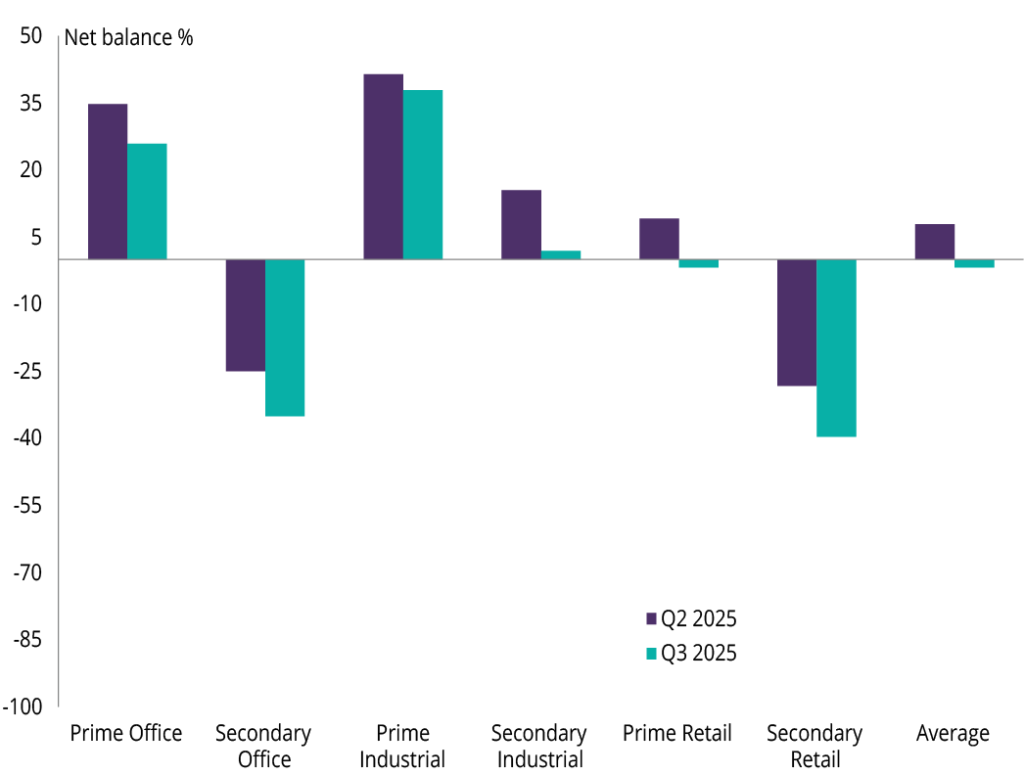
- Prime industrial and office assets are envisaged to move marginally higher
- Secondary office and retail are expected to remain under pressure in the next 12 months
- For alternative sectors, optimism in data centres remains undiminished.
Source: RICS, UK Commercial Property Monitor, Q3 2025
12-month rent expectations – broken down by sector
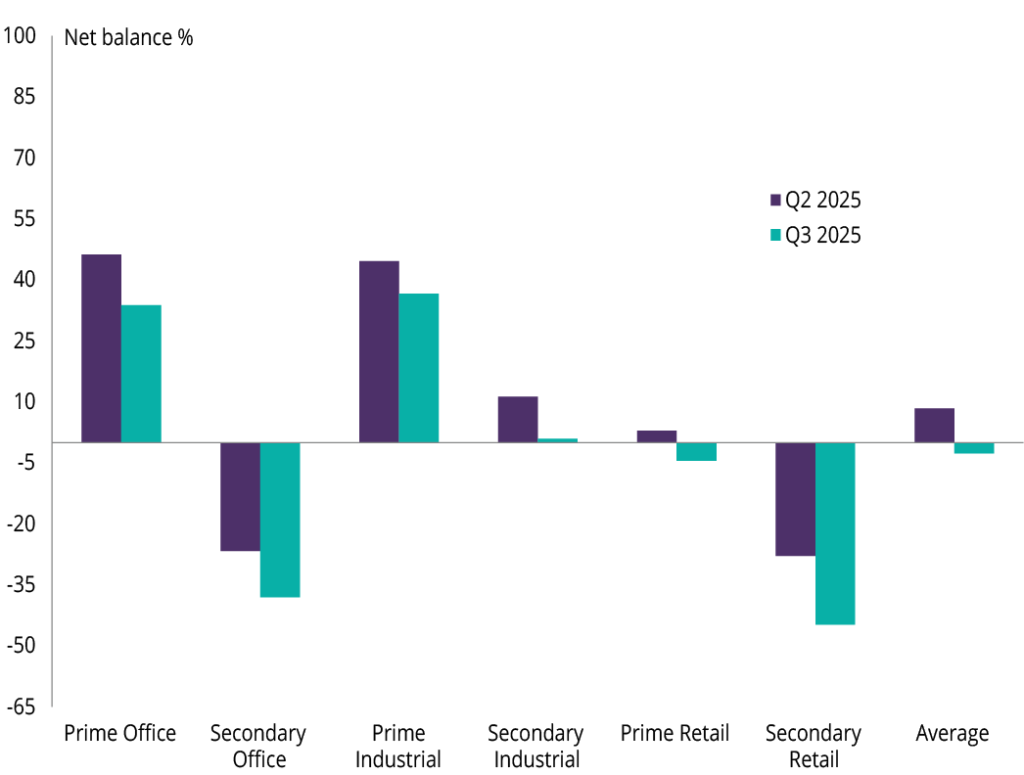
- Growth is expected to be concentrated in prime markets
- For the retail sector, rents are expected to rise for prime space and fall across secondary markets
- Rents in data centres, aged care facilities, multifamily residential, student housing and life sciences are all expected to see rental growth.
Source: RICS, UK Commercial Property Monitor, Q3 2025
Scottish market update
The Scottish commercial property market showed resilience in 2025 despite wider economic uncertainty.
Knight Frank analysed Real Capital Analytics data, finding that investment volumes hit £1.96bn at the end of last year. This is close to the five-year average of £1.97bn. Alasdair Steele, Head of Scotland Commercial Property at Knight Frank, commented, “While we have just about hit the £2bn mark, there are several deals that were close to concluding that will now fall into 2026, after a flurry of activity in November and December.”
Retail was the strongest-performing sector, accounting for £717m of investment, followed by offices which attracted £461m. Large office transactions included Quartermile One in Edinburgh and The Sentinel in Glasgow.
After a promising start for hotels in 2025, investment slowed in H2, reaching £322m by the end of 2025. Industrials accounted for £367m, which is the second-lowest level the sector has seen since 2020.
All details are correct at the time of writing (21 January 2026)
The value of investments can go down as well as up and you may not get back the full amount you invested. The past is not a guide to future performance and past performance may not necessarily be repeated.
It is important to take professional advice before making any decision relating to your personal finances. Information within this document is based on our current understanding and can be subject to change without notice and the accuracy and completeness of the information cannot be guaranteed. It does not provide individual tailored investment advice and is for information only. We cannot assume legal liability for any errors or omissions it might contain. No part of this document may be reproduced in any manner without prior permission